

Carbon markets and carbon credits have proven to be one of the most critical and innovative instruments within the global and national climate policy frameworks. With rising interest and evolving regulations in the field of carbon pricing, governments industries corporates and financial institutions are now showcasing increased attention to carbon markets and carbon credits.
This beginner’s guide provides a fundamental and structured overview of carbon markets and carbon credits. It answers various questions like what are carbon markets? what are the different types of carbon credits? And what are the main differences between compliance and voluntary markets and how they enable emission reductions?
By the end of this guide, readers will have a clear foundational understanding of carbon credits and the carbon market, enabling them to navigate climate policy discussions and emerging green finance opportunities with greater confidence.
What Is a Carbon Market?
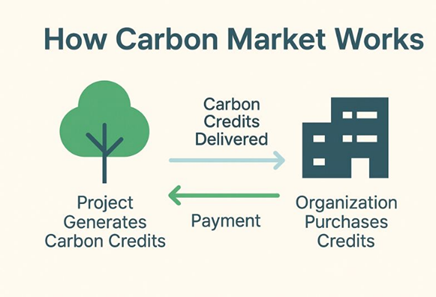
Carbon market, in a nutshell is a carbon pricing mechanism or a trading system that facilitates the buying and selling of carbon credits for various purposes (e.g., to meet climate targets and regulatory obligations, to compensate for unavoidable Greenhouse Gases (GHGs) emissions or to support and finance mitigation projects).
One tradable carbon credit equals one tonne of carbon dioxide (CO2) or the equivalent amount of a different GHG (CO2e) reduced, sequestered or avoided.
Carbon market mechanisms nowadays are being increasingly recognized by national governments and leading private sector actors as effective instruments for mobilizing green investments, accelerating emissions reductions, and advancing sustainable development pathways. By assigning a measurable economic value to verified emission reductions via carbon credits, carbon markets enable governments and businesses to incorporate emissions management into their financial and operational decision-making, incentivize investments in low-carbon technologies, and support the accelerated deployment of mitigation projects across sectors.
As a result, carbon markets have now become a critical tool for achieving climate targets at lower cost and with greater impact. This is further backed by a World Bank study that states that trading in carbon credits could reduce the cost of implementing countries’ Nationally Determined Contributions (NDCs) by more than 50%.
Understanding how carbon markets work and the difference between compliance and voluntary carbon markets is essential for effective climate policy and carbon pricing decisions.
What Are the Different Types of Carbon Markets?
Technically, carbon markets can be classified into two major types – compliance carbon markets and voluntary carbon markets.
What Is a Compliance Carbon Market (CCM)?
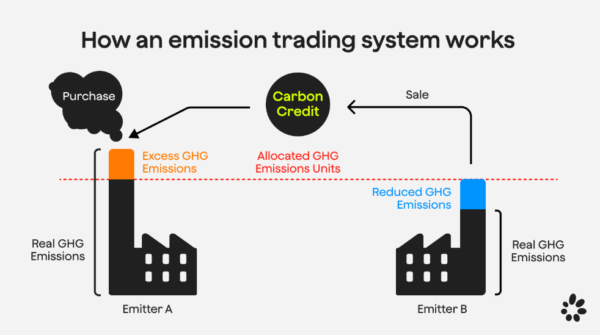
Compliance carbon markets are essentially government-regulated systems established under national or regional climate policies, and they primarily operate through an Emission Trading Scheme (ETS) based on the ‘cap-and-trade’ principle. As per the cap-and-trade model, a cap (limit), is set on the total amount of emissions that can be emitted by the obligated entities, and any emission allowances not used can be sold and/or traded in the ETS.
How Does an Emissions Trading Scheme (ETS) Work?
Obligated entities under the ETS receive an annual emission allowance or compliance credits and must operate within these limits. Entities that emit less than their allocated allowances may sell the surplus, while those exceeding their allocation must purchase additional allowances to remain compliant. This exchange of allowances creates a regulated emissions trading market that incentivizes cost-effective emission reductions across covered sectors.
Some common examples of CCM include the EU Emissions Trading System (EU ETS), India’s Carbon Credit Trading Scheme (CCTS) and Australia’s Safeguard Mechanism (SMC).
What Is the Voluntary Carbon Market (VCM)?
The voluntary carbon market, as the name suggests enables organizations and individuals to voluntarily purchase carbon credits or carbon units for various purposes. Globally, VCM transactions typically occur under independent standards such as the Verified Carbon Standard (VCS) and Gold Standard (GS). These independent standards ensure that these carbon units are generated through transparent methodologies, verified by accredited third parties, and issued with robust safeguards to maintain environmental integrity, additionality, and accurate emissions accounting.
Furthermore, it is also worth noting that the voluntary carbon market, once functioning largely beyond direct government regulation, is now undergoing a major shift. As carbon markets attract greater global scrutiny, countries across the world (including India) are putting in place new policies and oversight mechanisms. These emerging frameworks aim to strengthen environmental integrity and ensure that VCM transactions support, rather than conflict with, national climate commitments like NDCs. Several countries have already introduced domestic voluntary crediting programs (such as India’s Offset Mechanism under the CCTS and Thailand’s T-VER scheme) to better align voluntary market activities with national mitigation targets and strengthen overall governance of carbon credit generation and use.
What Is a Carbon Credit?
As highlighted, carbon credits are certified units that represent one metric tonne of carbon dioxide (CO₂), or its equivalent (CO₂e), that has been reduced, avoided, or removed from the atmosphere through a verified activity. These units then serve as the core tradable asset within carbon markets.
What Are the Different Types of Carbon Credits?
Carbon credits can be broadly classified into two types: Compliance Credits or allowances, for government-mandated markets like EU-ETS, and Voluntary Credits (sometimes referred to as offsets) and are majorly certified by standards like Verra or Gold Standard.
Furthermore, carbon credits can be further classified project-wise. This includes avoidance or reduction credits and removal credits. Avoidance or reduction credits are generated by preventing of future emissions via projects such as renewable energy projects. On the other hand, removal credits are generated through mitigation activities that directly extract and remove CO₂ already present in the atmosphere via projects such as use of Direct Air Capture (DAC).
Why Are Carbon Credits Important?
Carbon credits play an important role in the global carbon market by offering a practical way for countries to support emission reduction efforts. At the national level, they strengthen a country’s ability to monitor, report, verify, and track progress toward climate commitments, particularly its NDCs. When carbon crediting mechanisms are integrated into national climate plans, governments gain a clearer picture of verified emission reductions, improve transparency around mitigation efforts, and accelerate progress toward decarbonization and long-term net-zero goals.
For governments and public institutions, developing carbon market instruments brings direct benefits – it helps mobilize climate finance, encourages investment in mitigation activities, and supports the growth of a low-carbon economy. For businesses, organizations, and individual consumers, carbon credits offer an accessible way to contribute to high-quality emission reduction projects and participate in the broader shift toward a climate-neutral future. This proves that carbon credits enhance financial value, social impact, and environmental benefits not only at the global climate level and but also at the individual level.
What Are the Key Trends Shaping the Future of Carbon Markets?
The global carbon market is undergoing a period of major change as regulations evolve, corporate interest grows, and expectations around environmental integrity become more rigorous. Many countries are now weaving carbon pricing instruments into their national climate strategies, and the implementation of Article 6 under the Paris Agreement is reshaping how carbon market transactions can take place across borders. In parallel, several governments have begun introducing taxation measures for carbon market transactions. When thoughtfully designed, these tax frameworks add an additional layer of transparency, help avoid double counting and strengthen the credibility of domestic carbon market systems.
At the same time, the voluntary carbon market (VCM) is shifting in favor of higher-quality credits, with buyers increasingly demanding stringent methodologies, stronger MRV, and clearer disclosure. These developments have also intensified discussions around market integrity, including concerns related to greenwashing, double counting, and the treatment of local and indigenous communities – issues that are explored in greater detail in our discussion on carbon piracy and integrity risks in carbon markets.
Technological advancements such as blockchain-enabled registries to AI-driven MRV tools and satellite-based verifications are also redefining how carbon projects are monitored and tracked, helping prevent double counting while lowering costs and improving traceability. Together, these developments are steering carbon markets toward a more mature and trusted space, positioning them as a key mechanism for mobilizing climate finance and supporting global progress toward net-zero goals.